Thursday, November 29, 2018

A little help staying centered during the Holiday Season

Disillusioned with the consumer driven yearend holiday season, which seems to start earlier and earlier every year, where Black Friday overshadows Thanksgiving and robs us of the symbols and symbolic messages that bring value to our spiritual and mental health, I have returned to Mariann Burke’s Advent and Psychic Birth. Rich in depth and metaphor, I’m using it as a daily devotional, to help me stay focused during this runaway time of the year where we can easily get lost to external events and mindsets that lead us away from ourselves and the meaningful relationships in our lives. I’m not against gathering together for holiday parties and celebration, which I consider a normal integral part of our lives. My goal, however, is to stay focused on the symbolic meanings of these holidays so that they can be celebrated with a greater understanding of how and why they came into existence, and it turn experience them with more meaning and joy.

Though I am the publisher of Advent and Psychic Birth, I currently reading and using the book as a daily devotional for my personal mental and spiritual health. This is not an advertisement meant to ‘sell’ you a Fisher King Press publication. It is a message only to bring awareness to a very worthy and valuable publication that speaks to all of us during this time of the year. I republished Advent and Psychic Birth a few years ago, after it had been out-of-print for nearly two decades. I published it for a few reasons, much of which is related in the previous paragraph, but also because it has eternal life, an eternal message that should never be ‘out-of-print’. I’m proud and grateful to be the publisher of Mariann Burke’s Advent and Psychic Birth as well as her book, Re-Imagining Mary: A Journey Through Art to the Feminine Self. Thank you, Mariann Burke, for digging deep into the depths of soul and bringing back to us your hard-earned gold!

Here are a couple of paragraphs form Advent and Psychic Birth:
Whatever one's religious persuasion one cannot help being touched by the poetry of the Hebrew and Christian biblical Advent texts. The Advent liturgy offers a rich fare of images: images of death and destruction, images of hope, of struggle, of waiting, of pain, puzzlement, questioning, doubt, images of birth and of love. Psychologically speak­ing, it is more important to experience an image than to interpret it or to relate it to mythological sources, helpful though this may be. Experiencing opens us to the energiz­ing power of the image which "feeds" us, giving us sub­stance and meaning. Whether the image comes from the Bible, Koran, I Ching, Tarot, or from our dreams and visions, the image brings us in touch with a wisdom and shared experience of humanity. Images of Advent speak to us of our yearning for life, even as the One whose birth we celebrate came to give us life "to the full."
Probably no other time of the year evokes in us such a range of emotional response--from sadness to joy--as the weeks leading up to the feast of Christmas. The word, "Advent," from the Latin, adventus, means "coming" or "approach." The word connotes a longing or hunger for something more in life, something intimated but still unfelt. For Christians this longing focuses on the divine child, a child who was embodied in the Jesus of history, and who, from a psychological perspective relates us to "unborn" as­pects of ourselves. Advent, then, is the season of the unborn. And it is this aspect of Advent that we will explore as images of psychic pregnancy and birth. Each of us nurtures some promise that wants to be born. Psychic birth refers to any potential aspect of ourselves that longs for realization; it refers to our "becoming" who we are meant to be.

Saturday, September 12, 2015

On Educating Hearts and Souls


Fundamentalism in any form, religious or otherwise, divides humanity - divides individuals at the very core of their being. When we are at odds within, we in turn become at odds with others. Reconciliation must first take place within our very own beings, becoming reconciled with aspects of our selves that have been marginalized and cast away as a useless 'other' - only then can we become reconciled with all of our brothers and sisters in this world. Education must be more than heady intellectualism - in addition to our minds, we must become educated within our hearts, within our souls.

Lifting the Veil is a book that can help educate our minds, as well as our hearts and souls.

Mel Mathews, is the author of several novels, including the Malcolm Clay Trilogy (Fisher King Press). His books are available from your local bookstore, a host of on-line booksellers.  © 2015 Mel Mathews

Tuesday, August 13, 2013

Zen and the Poetic Insight of Alvaro Cardona-Hine


Mel Mathews: Having recently published one of your collections of poetry, The Song Less/on (il piccolo editions), undoubtedly I am a big fan of your work. However, today I'd like to learn more about your just published Phantom Buddha (Alba Books). Why the title: Phantom Buddha?

Alvaro Cardona-Hine
Alvaro Cardona-Hine: Phantom Buddha is an autobiographical novel dealing with the time in my Forties when, after reading extensively about Zen Buddhism, I began actual practice under a Japanese Zen Master who turned out to be a womanizer. The woman I was with was lured away from me. It was a painful experience that took me several decades to translate into a novel. There is a blend of reality and dreams I had during those days that accentuates the condition of a man in the most dire of circumstances. My friend Pierre Delattre, author of Tales of a Dalai Lama, consider this work of mine to be a breakthrough into a new kind of literature.

MM: How long has Phantom Buddha been in the making?

ACH: I began to write Phantom Buddha decades ago but, for one thing, the painful nature of the experience made postponing and rewriting a matter of many years. The fact that my wife, Barbara McCauley Cardona and I, have started our own publishing firm, made me abandon any doubts and complete the work.

MM: What impetus fueled the writing of Phantom Buddha?

ACH: Phantom Buddha is essentially an expose of a man who has recently been exposed in the Buddhist community and by the New York Times for the moral fraud that he is. Zen is the clearest, most demanding, and most subtle paths to personal liberation that exists, and there is absolutely no room in it for scoundrels such as Joshu Sasaki who takes advantage of the cupidity of female students.    

I was able to overcome my initial disappointment and went on to study with Prabhassa Dharma Roshi, who some 14 years ago, before she died, named me a sensei, or teacher.

Tuesday, April 23, 2013

"A male 'Eat, Prey, Love.'"


Man in Search of His Anima, a.k.a. His Soul

Menopause Man-Unplugged 
reviewed by Elizabeth Clark-Stern

It was - in retrospect - a risky thing to do: reading a book written by my publisher. It is fiction, but every writer's soul and character comes through in their work. What if his book revealed a person different from the one I knew through phone calls and emails? What if I didn't like it? All reasonable cautions. But I was curious. As it turns out, so is Malcolm Clay, the protagonist. Curious, rebellious, always drawn to the off-center. Well, so was I, starting with the second book in the series, Menopause Man-Unplugged, after giving the first, LeRoi, to a friend.

"I loved it," he said, "A male Eat Prey Love."

I was intrigued. I learned from reviewing another Fisher King Book, Eros and the Shattering Gaze: Transcending (Male) Narcissism by Ken Kimmel, that a woman can learn a great deal about herself by reading books about men. I was still nervous. I knew Mathews' book wasn't academic like Kimmel's. Mel had to be capable of creating a fictional world I was willing to dive into, get lost in, and enjoy, or would I be lost in a quagmire of words and images I couldn't relate to?

Turns out, my worries were a totally ridiculous spinning out of my own "dark side." I fell right into this book - a true Page Turner. While it is technically fiction, it reads like the journal of a very real man, with all his quirks, complexities, and goofball humor, falling for the wrong women, drawn to the wrong situations while desperately searching for the light. I don't know if this was Mathews' intention, but it reads like a prose version of the goofy guys in movies like Hangover - with a very real quest at its core. He throws in poetic references that belie his superficial kick-back persona, such as a framed copy of 'The Definitive Journey' by Juan Ramon Jimenez, Spain's great poet and author of one of my favorites, Platero and I.

Monday, December 10, 2012

the song less/on - "some of the best ever written"

the song less/on

A book of poetry by Alvaro Cardona-Hine

“Some of the best ever written . . .” 

--Tom McGrath in The National Guardian 

reviewing the haiku in The Gathering Wave.

“Cardona-Hine is far more tuned to silence than Eliot; there are no phases to his theology. He offers no disciplines, nor even Zen vacancies; he offers arrivals . . . This gentle poet has little to do with the hysterical attenuated surrealism which has in recent years dominated the better little magazines. Or with archetypes of the Great Mother or other theorizing . . . It is understandable that poets want to move out into the universe, to dream of being moles, to sink into mineral veins, to make wild dissociated images that dissolve the self. But Cardona-Hine preserves the sense of human self-hood, human wonder, adventure.”
–Benjamin Saltzman in Kayak 
reviewing Words On Paper.

Alvaro Cardona-Hine was born in Costa Rica in 1926 and was brought to the United States by his parents in 1939. By 1945 he was writing poetry then went on to translate Cesar Vallejo, write novels, make a living as a painter, and compose music which has been performed in various parts of the country. He is the recipient of an NEA grant, a Bush Foundation Fellowship and a Minnesota State Arts Board grant. He lives with his wife, the poet and painter Barbara McCauley, in the small village of Truchas, in New Mexico, where the two manage their own gallery.

Product Details
* Paperback: 170 pages
* Publisher: il piccolo editions; First edition (Jan 1, 2013)
* Language: English
* ISBN-13: 978-1926715889
* www.fisherkingpress.com

Fisher King Press publishes an eclectic mix of worthy books including 
Jungian Psychological Perspectives, Cutting-Edge Fiction, Poetry, 
and a growing list of alternative titles. 
Mel Mathews, is the author of several novels (Fisher King Press). His books are available from your local bookstore, a host of on-line booksellers, or you can order them directly from his website at: www.melmathews.com © 2012 Mel Mathews

Friday, July 27, 2012

Solitude, Creativity, Opus House

Opus House
A place for Solitude and Creative Work

Opus House is a comfortable adobe home near the old Spanish village of Truchas in the Sangre de Cristo Mountains of Northern New Mexico. Sitting at 8300 feet elevation, 45 minutes from Santa Fe on the High Road to Taos, Opus House is offered to selected individuals of all callings and backgrounds as a place of solitude and creative work. It is seen as a place to be for a week or so to concentrate on a chosen creative process.

For those interested in exploring this offering, contact:
Opus House, 1671 State Road 76, P.O. Box 471, Truchas, NM 87578


A number of Fisher King Press authors have spent time at Opus House and Truchas Peaks Place. Patricia Damery and Naomi Ruth Lowinsky wrote the preface, the section introductions, and flowed together the essays that comprised Marked By Fire: Stories of the Jungian Way. Mel Mathews has completed a number of Fisher King Press titles while hiding away at this sacred place.

Saturday, July 07, 2012

The Timekeeper has come to Town

Timekeeper by John Atkinson

Within the first few pages, John Atkinson's Timekeeper had weaved its essence around my heart and refused to let me go. Written in the same spirit as Sue Monk Kidd's The Secret Life of Bees, Timekeeper is a magnificent tale of a young boy who can't read, or at least he hasn't found the means to do so up to this point in his life. Misunderstood by his teachers and elders, and physically beaten into the ground by his father, Johnnyboy runs away from home at the age of fourteen and sets off into the unknown to find himself. What he couldn't find in his own father, the universe provides for him in a multitude of miraculous ways. In spite of all his suffering and adversities, Johnnyboy's spirit remains in tact... better yet, like a boxer taking a relentless barrage of punches, he spits his beating into the ringside pail and comes out dancing like never before into the next rounds/chapters of this magnificent tale of redemption. Readers, Booksellers, Journalists, Reviewers, Critics, and even you Movie Makers, about all I can tell you is, 'Better get ready 'cause the Timekeeper is coming to town!' --Mel Mathews, USA Today

Wednesday, July 04, 2012

Freeing our Authentic Selves

Review by Mel Mathews

Filled with insight and wisdom, Free the Children is most unique and original in its own sense, yet equal in rank to the works of Carlos Castaneda and Don Miguel Ruiz. This beautifully written story is about a love shared between a father and son. Yet, it is not about a father ‘fathering’ a son. Quite the opposite – Boye, with an innocent wisdom that has not been distorted by the conventional impositions of social institutions, teaches, or better yet, ‘boys’ a Father. Bruce Scott reclaims and liberates his own lost innocent self as he and Boye travel the country, meeting up with bizarre people in the most uncanny places, and sharing profound experiences that bring about a shift in awareness and alters their way of seeing and being in the world.

Sunday, July 01, 2012

Who is Malcolm Clay, you ask?

"Malcolm Clay is the story of everyman."

"Malcolm Clay is the story of everyman. He is every man who ventures into life and love. The every man who experiences the vicissitudes of the ecstasy yet fear and pain that life and love may bring. Author, Mel Mathews, brings to light the engaging energies of his novels' protagonist, Malcolm Clay, both in his external happenings and also in the soul making substance of his inner on-going life. He allows us to hear the inner dialogue, to touch the feelings, to view life as if an X-ray vision of a man's soul. In an appealing manner, a crisp and crusty narrative, we, as reader, also envision life and soul."
– Nancy Qualls-Corbett, Jungian Analyst & Author of The Sacred Prostitute

Sweet Alabama Mountain Music

review by Mel Mathews

What a fabulous tale! The weekend was covered with a hefty to-do list, then I opened up Ramey Channell's Sweet Music on Moonlight Ridge and everything else fell away. The woods around Moonlight Ridge are filled with magical secrets and possibilities and eight-year-old Lily Claire Nash and her cousin Willie T (both born on the very same day and at the very same time) are full of adventure.

Saturday, October 22, 2011

Tips for Accessing your Creative Spirit

Art & Fear: Observations on the Perils and Rewards of Artmaking makes for a fine companion to Lawrence Staples’ The Creative Soul: Art and the Quest for Wholeness. If you are looking to tap into your own creative spirit, both of these fine publications will help.


Art & Fear: Observations on the Perils and Rewards of Artmaking
by David Bayles and Ted Orland
ISBN 978-0961454739. Trade Paperback, 122 pages

What is your art really about?
Where is it going?
What stands in the way of getting there?

These are questions that matter, questions that recur at each stage of artistic development - and they are the source for this volume of wonderfully incisive commentary.

Art and Fear explores the way art is created, and the reasons it often does not get created, and the nature of the difficulties that cause so many artists to give up along the way. This is a book about what it feels like to sit in your studio or classroom, at your wheel or keyboard, easel or camera, trying to do the work you need to do. It is about committing your future to your own hands, placing Free Will above predestination, choice above chance. It is about finding your own work.

Sunday, October 09, 2011

The Creative Seed

The Seed of a Creative Life

by Lawrence Staples,
author of The Creative Soul: Art and the Quest and Guilt with a Twist: The Promethean Way


Active imagination is a technique developed by C.G. Jung to help amplify, interpret, and integrate the contents of our dreams. When approached by way of writing, active imagination is like writing a play. One takes, for example, a figure that has appeared in one’s dreams. Usually, these figures express a viewpoint quite the opposite of one’s normal conscious view. Sometimes it is a male or female, shadow figure. At other times, it may be a feminine, anima, or maternal figure.

One starts to converse with the figure in writing. One challenges the dream figure and lets him/her challenge the dreamer. The dreamer asks the figure why he appeared in the dream. He asks the figure what it wants from him. Then, the ego, like a playwright, puts himself as best he can into the figure’s shoes and tries to express it and defend its viewpoint. There ensues a dialogue between the writer and the opposite figure in his dream or piece of writing. With practice one can become accomplished at expressing both viewpoints, just as a playwright does. One gets better at this the more one does it.

The technique of active imagination tends to detach the qualities and traits that are first seen in a dream or in a story as belonging to external persons, and coming to see them as belonging to one’s self. Active imagination, then, helps the writer become conscious of his opposite qualities by forcing him to give voice to figures, like shadow figures, that carry qualities opposite those of his ego. These qualities personify the rejected opposites that are present in the unconscious. This technique helps recover them and make them available to the ego and consciousness without necessarily having to act them out.

Following is an impressive and rich example of the power of this technique to affect and even shape our lives. It’s an active imagination done by Mel Mathews when he was in his late thirties. He was an extremely successful salesman who was, nevertheless, unhappy with his work and life. Despite his high income, work had lost its meaning for him. He had entered Jungian analysis in order to help him out of his suffocating existence and find a new and different way. He had a powerful dream that he took to his analyst.

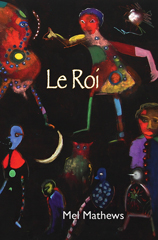
His analyst suggested he do active imagination with one of the figures in the dream. His is a beautiful example of active imagination that led to much more than a dialogue. It became the seed of a creative life that grew and flourished into a wholly new career. Out of his active imagination came a novel, LeRoi - Book 1 of The Chronicles of a Wandering Soul series, which was then followed by several other novels, including Menopause Man-Unplugged and SamSara.

The power of the active imagination is seen in the fact that it unearthed in Mel some deep hidden spring of creativity that suddenly gushed forth. Apparently, he had been living a life of suspended animation that lay there until some psychic prince awoke it. He had the following dream:

A woman was sitting in a diner, in a booth smoking. “Excuse me, I wonder if you could put your cigarette out?” I asked. She ignored me. A few minutes later she lit up again. I stood up, walked around to her booth, grabbed her pack of smokes and the ashtray and walked out the front door. I dumped the ashtray and stepped on her lit smoke; then, I dropped her pack and stomped them as well. I walked back inside, slammed the empty ashtray down on the coffee counter and sat down. A petite pony-tailed brunette walked up with the iced tea pitcher to refill my glass. “Can I have some more ice please?” “Sure,” she answered, “I’m sure (Flo) the boss-lady will be out in a minute,” the brunette said, as she turned around with my ice. “What does she want?” “You’ll have to ask her yourself.”

Mel discussed the dream with his analyst who suggested a dialogue with the boss-lady.

Following is his active imagination with Flo, the name of the boss-lady. This brief dialogue is to his novel what an acorn is to an oak tree. This brief dialogue apparently contained all the genetic codes necessary to make a novel just as an acorn has the genetic codes that lead to an oak tree.

Flo: Howdy.

Mel: Hi.

Flo: Purdy hot day, huh?

Mel: I can stand the heat. It’s the stray cigarette smoke that sets me off.

Flo: So that gives you the right to run off one of my regulars.

Mel: I asked her to put it out.

Flo: Did you ask her or did you beat around the bush with some rude indirect comment?

Mel: Lady, I don’t know who you are or what’s on your mind, but I really don’t need any more crap today.

Flo: Well kid right now you’re in my diner and you’re runnin’ off my patrons.

Mel: Oh great.

Flo: I’ve dealt with your kind for years so let’s just cut to the quick.

Mel: Look, lady, I’m sorry if I offended anybody here, but I’ve got some problems. My MG is broken down across the street.

Flo: So what?

Mel: Things just aren’t falling into place today.

Flo: Would you like some chocolate milk little boy, or how about your ass wiped? In this café, the world doesn’t revolve around you.

While the creative process is different for each individual, one can sometimes discern similarities. The seed that unleashed Mel’s creative process was a dream and a few sentences associated with the dream. His process bears some resemblance to the process by which Isak Dineson created her work.

Mel Mathews' development as a person and a writer is a wonderful testimony to the power of creativity to shape our lives and connect us to our souls. His dream and the dialogue that flowed from it to create LeRoi is an incredibly rich and impressive example of active imagination, as I understand it. His experience of active imagination is one of the most powerful examples I have ever witnessed. His dialogue with Flo seemed to unearth for him a huge reservoir of suspended animation that poured forth into the world and continues to flow. Actually, "Flo" and "flow" do seem somehow related. Mel's experience is enough to encourage therapists not only to use active imagination with their clients but also with themselves."

    Wednesday, September 28, 2011

    Snakes! Everyone should have at least one. . .

    Review by Mel Mathews

    Snakes, a novel by Patricia Damery

    Go West Young Lady! Love – Sex – Naiveté – Family – Values – Commitment – Betrayal . . . Patricia Damery weaves a seductive tale about life’s insoluble contradictions. A Midwestern farm girl leaves the confines of her family heritage and is transformed by life’s vicissitudes. Snake stories, symbols of transformation, are cleverly intertwined in this highly entertaining novel as Angela, the heroine, undergoes numerous rights of passages, and comes to terms with life - her life – exactly where, when, and how it unfolds. Highly recommended, Snakes is deeply rooted in Mother Earth—and Soul.

    Mel Mathews' book reviews have been published in USA Today and many other notable publications. Mel is the author of several novels, including the Malcolm Clay Trilogy (Fisher King Press). His books are available from your local bookstore, a host of on-line booksellers, or you can order them directly from his website at: www.melmathews.com

    © Mel Mathews - permission to reprint granted with a link back to www.melmathews.com

    Sunday, September 18, 2011

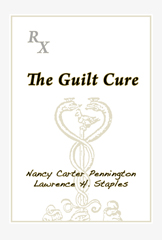
    SamSara and The Guilt Cure: a Homeopathic Remedy


    From Pennington & Staples The Guilt Cure:

    Early Wounds, Guilt and Repeating Patterns

    All of us carry psychic wounds that were inflicted in childhood. In order to be safe and to be loved, we cut off and repressed thoughts, feelings and behaviors that were unacceptable to our parents. It is this “cut” that wounds us. None of us escapes these wounds because there are no parents to whom all thoughts, feelings and behaviors are acceptable. No parent gets it right. We are prone to think that the parent who neglects us is more wounding than the one who is over-solicitous and attentive. Both wound us. The wounds are different but they both hurt.These wounds become our developmental deficiencies. Our life long challenge is to recover the rejected qualities in order to become whole and live fuller lives.

    Guilt lies behind these wounds. We avoid the unacceptable qualities in order to escape the painful guilt we are wired to experience when we violate parental values and wishes. And the behaviors we adopt early in life to avoid guilt, punishment and loss of love, continue throughout our lives as repeating patterns of behavior. If guilt is a necessity in life, then psychic wounds are also necessities. These necessary wounds determine the developmental path we must follow if we are to recover those cut off qualities and heal our wounds. We have to bear painful guilt if we are to become whole, just as we have to bear painful hunger if we are to lose weight.

    It is the urge to develop and become whole that lies behind our repeating patterns. One pattern that most people experience is the tendency to keep choosing a partner that has the same difficult qualities as the previous one. Usually we are attracted to someone opposite, someone who carries qualities that we ourselves can’t express. The persons we are attracted to may superficially seem different, but psychologically be much the same. For example, we may always be attracted to someone who is relatively unavailable. We then repeat the childhood experience we had with one or both of our parents.

    The way of dealing with the unavailability may differ from child to child. One sibling may react by clinging, by expressing its neediness, by clamoring for attention or complaining when it is insufficient. Another sibling may react just the opposite. He/she may resolve to become self-sufficient and demand little from the parent. This sibling may take care of the parent and learn that safety lies in being the good boy or girl who never creates a burden for the parent. The other demands to be taken care of and is a real burden to the parent.

    Later in life, these two are attracted to each other. One needs to be taken care of. The other needs to take care of someone. As it turns out, they are both needy. But both are unconscious of it and deny it. It’s the basis for the widespread phenomenon of co-dependency. It’s a secret collusion. On the surface, one feels angry and rejected if his every need isn’t being anticipated and met. But deep inside, he feels guilty because he feels unworthy of care and attention. Meanwhile, the other feels just the opposite. Consciously, she feels guilty if she isn’t anticipating and taking care of every need of the loved one. And underneath she may be filled with anger and resentment when her caretaking is not deemed satisfactory or is not appreciated. Her sense of self worth depends on proper acknowledgement of her efforts.

    The displeasure and dissatisfaction that arise actually give us a hint about how to break this pattern. After many painful experiences, we eventually discover that healing takes place when we can treat the partner as we have been treated. The healing element is almost always homeopathic. Rather than trying to get the partner to behave differently, we have to take on some of the very traits we thought we wanted them to change. We have to develop traits that we have spent a lifetime trying to avoid or deny. The always available person becomes less available. The always unavailable person become more attentive.

    In order to behave homeopathically, we have to do inner work in the shadow where our opposite qualities have been stored. We have to become very conscious of our own feelings. For example, a caretaker cannot become unavailable without experiencing guilt and anxiety. If we become conscious of our guilt and anxiety as it arrives, we can name it and bear it. If we resolve to bear those feelings, they will not last long. The same thing happens in dieting. If we are not watching our feelingscarefully, the hunger comes and we grab a cookie without reflection. If we feel and name the hunger just as it comes and resolve to bear it, the hunger will not last long.

    In Mel Mathews’ novel SamSara, we see that the hero, Malcolm Clay, is caught in a repeating pattern. He is always strongly attracted to women who are unavailable. He meets this beautiful woman named Kelli. Kelli is focused on her own work projects and is not readily available to others. Malcolm falls for her. Her behavior is random and intermittent. He never can reliably count on her showing up for a date or returning a call. Sometimes she will; sometimes she won’t. Her behavior drives Malcolm crazy as he chases her around the world. Eventually, he ends up in Ireland where she lives and he is repeatedly let down by this incredibly attractive woman.

    After much hurt and pain, Malcolm is finally able to let go. He does it with a homeopathic treatment. He gives her a dose of her own medicine. She invites him to meet for a drink at one of the local hangouts. When he sees her coming this time, he slips out the back door, gets on a train and heads for the airport. She arrives at the café and soon begins to call Malcolm trying to find out where he is. His phone rings just as the train approaches the air terminal, and he notices a young boy crying in his mother’s arms. “Hey kid, you’ve got a call,” he says, handing the whining boy the phone before stepping off the train.

    It is likely that Malcolm had to bear much anxiety and guilt in order to stand Kelli up. Malcolm values reliability, dependability and keeping his word. It makes him angry when others don’t behave the same way. But, in this moment, he had to save himself by finding in his unconscious a quality that had been put there long ago in order to safely traverse childhood. He had to become unavailable. Malcolm also had to suffer through much painful yearning, just as an alcoholic does when he gives up something that once made him feel good but later made him feel bad. And like an alcoholic who gives up alcohol, he has to spot the yearning the moment it begins, acknowledge it, name it and suffer it momentarily, perhaps several times until the yearning passes.

    Thursday, July 09, 2009

    Give me that old time religion, it’s good enough for me . . . or is it?

    by Mel Mathews

    Perhaps that 'Old Time' religion has failed us, or at least the deeper meaning of symbols and metaphors have been lost to misinterpreted literalism and that 'old king,' religious fundamentalism. Blindly following old time beliefs and attitudes in their many forms and guises is following our forefathers right over the cliff and into a vast sea of disillusionment and meaninglessness. Will we repeat this by following along with a host of fundamentalist ideals, the endless pursuit of materialism at the expense of our ecology, and other forms of meaningless neurotic suffering, or we will be moved to willingly and consciously suffer the unknown, until these old time religious symbols become alive within and take on authentic meaning as opposed to being a useless, lifeless, hand-me-down relic?

    Instead of completely running away from, or blindly following, perhaps we could begin to question these old religions and fundamentalisms, begin to confront and dialogue with these calcified God-Images, and find that lost nugget of gold - the transcendent. After all, like a reoccurring nightmare, these haunting literalized religious concepts and other 'old king' values will not go away until their embedded images are exposed and truly given their due.

    Edward F. Edinger’s Transformation of the God-Image and Lawrence W. Jaffe’s Celebrating Soul are two fine publications that address such concerns.


    Transformation of the God-Image
    by Edward F. Edinger
    with a foreword by Lawrence W. Jaffe

    "Whoever knows God has an effect on him."
    --C.G. Jung, Answer to Job.

    From Lawrence W. Jaffe’s Foreword of Transformation of the God-Image:

    Despite the Biblical imagery, this book is not concerned with traditional religion. Its subject, rather, is psychology, the scientific study of the soul. References are to Job, God and Christ because our deepest feelings still resonate to that imagery. Put another way, the reason for the Biblical references is because "Jungian psychology has the task of introducing to the world a new world view" (Edinger, Aion). The roots of this new world view lie in the Judeo-Christian myth.

    If, as Edinger predicts, Jung's works are one day read as Scripture once was--for sustenance of our souls, for moving words that touch us to the heart, for reassurance, guidance and orientation--Answer to Job will surely occupy a unique place in the Jungian canon. The special status of Answer to Job as the most complete statement of Jung's essential message has long been acknowledged by Jungians, who have discussed it in countless seminars and conferences since its publication in 1952.

    What has sparked all this interest is that the central theme of Answer to Job--the transformation of God through human consciousness--is the central theme, too, of Jungian psychology. Not long before his death Jung himself affirmed its importance, remarking that he would like to rewrite all of his books except Answer to Job, which he would leave just as it stands.

    Answer to Job contains the kernel, the essence, of the Jungian myth, and Edinger's study of it, at once erudite and down-to-earth, thoughtful and heartfelt, evokes that essence with unequaled clarity and power.


    Celebrating Soul by Lawrence W. Jaffe

    "Man has a soul and there is a treasure buried in the field."
    --C.G. Jung

    People are beginning to bump up against the limits of materialism and rationalism, realizing that these fail to offer something essential, a purpose in life. Although a few turn back to institutional religion for orientation, many find that road barred to them by their reason and their skepticism. Whatever form the new religion takes it must leave a large place for reason. The new religion will therefore be the product of a marriage between reason and faith, science and religion.

    We cannot do without meaning in our lives. Meaning cannot be established objectively; it arises only through a relationship with the inner, subjective world. But it is precisely that realm that has been discredited in our day by the misapplication of the scientific spirit. In compensation, this book describes and gives examples of the inner life in order to help the reader sense the reality of the soul. It explores the spiritual significance of Jungian psychology--its message of personal and cultural renewal for a civilization that has lost its sense of purpose.

    In Celebrating Soul, Lawrence Jaffe helps to expose what has been lost in literal translations and brings us into deeper relationship with the symbolic and metaphoric value of concerns such as:
    * The New Religion
    * The Jungian Myth
    * Jungian Spirituality
    * What Is Our Purpose in Life?
    * The Hymn of the Pearl
    * Breaking the Chain of Suffering
    * The Golden Rule and the Iron Rule
    * The Wounded Inner Child in the Bible
    * The Lesson of Job
    * The Meaning of Suffering
    * Holding the Opposites As Service to God
    * Wrestling with the Angel
    * The Redemptive Value of Consciousness
    * A New Form of Worship
    * The Healing of Childhood Wounds
    * Success Versus Consciousness
    * Jung on the Life of Christ
    * Studying Torah and Studying Jung
    * Redemption Through Shadow Work
    * A Psychological View of the First Commandment
    * Testimony to the Holocaust
    * Death and Resurrection
    * Being "Born Again"
    * Individuation and the Bible
    * Jung and the Bible on Love
    * New Life in Late Life
    * A Psychological Gloss on a Benediction
    * The Problem of Prayer
    * Christ As a Model for Individuation
    * Reason and Statistics
    * Self-Knowledge Gives Meaning to Life
    * The Answer Lies Within
    * Psychotherapy As Sabbath

    Tuesday, June 30, 2009

    An Authentic 21st Century Man

    Article by Mel Mathews 

    Not long ago while listening to a NPR broadcast concerning Masculinity in the 21st Century, I was caught up by an interview of a woman journalist who had written about 'what it means to be a man in the 21st century.' The concept of a woman reporting on and defining, or attempting to define, masculinity was a bit off-putting. We tread on thin ice when a woman, or women define manhood and/or masculinity, just as we do when a man, or men attempt to define women and femininity. Sure, we all carry these contra-sexual aspects within, but that doesn’t make Man an authority on femininity, nor Woman an authority on masculinity, anymore than it makes a lefty an authority on a righty. The interview soon shifted away from a woman’s definition of masculinity to pop-cultural definitions of manhood. Perhaps I was still ruffled by this lefty-righty thing, but I also considered it quite shallow to have masculinity or femininity defined by fleeting fashions of pop-culture, for as naturally as DNA defines genetics, archetypal patterns define the psychological and spiritual makeup of masculinity and femininity—not passing trends.

    Now, speaking as a man about masculinity, I can say that many 21st century men have been raised by women—without a masculine role model—and what they've learned about being a man has been defined by the media, the women’s movement, and many other distorted social norms. Often, such men discover that they are no longer able or willing to carry these externally imposed values and instead seek alternative definitions of masculinity and lifestyles. Some would call these periods of change a crisis; others would consider this a step in the direction of mental health. Regardless of how we label this time of soul-searching, it ultimately calls for a willingness to suffer the unknown. The rewards for such courage often prove quite beneficial. For those willing to take on the task of becoming an 'authentic' man, one can expect to gain a more defined sense of self who is moved by his own internal values, and in turn experience a more meaningful and fulfilling life.

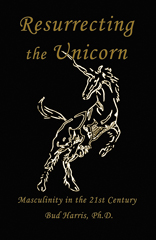
    However, all the compensatory posturing, chest-pounding or drum-beating in the world won't revive this great masculine spirit. This can only be accomplished by developing a deeper relationship to soul, to the archetypal patterns or energies that comprise the core aspects of our beings. The mental landscape of metaphors—dreams, stories, myths, fairy tales—deal with the eternal truths of human nature and are the language of soul. In the recently published book Resurrecting the Unicorn: Masculinity in the 21st Century, Bud Harris masterfully guides readers deep into the realm of metaphors where we can examine the evolution and development of human consciousness and reclaim discarded, yet much needed, integral aspects of our masculine natures.

    "True masculinity—not the macho type—is needed for men to be strong enough to meet the feminine in themselves. For this they must find their own masculine face—not a face defined by women," suggests Bud Harris in Resurrecting the Unicorn. Harris then delves into the fairy tale, "Fyrtoiet," better known as "The Tinder Box" by Hans Christian Andersen, where an "Elemental Blueprint for Developing Masculinity" is extracted from the symbolic metaphors of this wise old tale.

    Perhaps it’s time to pick up where Robert Bly's Iron John and Sam Keen's Fire in the Belly left off in the last part of the 20th century. If you're ready to explore and claim an 'authentic' masculinity from a place that calls for a great deal of courage, where truth, values, and integrity are defined from within, not by antiquated beliefs or pop-culture, then Bud Harris' Resurrecting the Unicorn is certainly worthy of your time and attention. Makes for a great gift to a husband, father, brother, and particularly for women who are raising boys.

    Mel Mathews' articles and book reviews have appeared in many syndicated publications. He is the author of a series of novels that portray a man’s struggles as he goes against the grains of his upbringings and emerges as a renewed man who is guided by his own inner truth and hard-won wisdom. Learn more about this reviewer and his publications at: www.melmathews.com or www.fisherkingpress.com

    Permission to reprint this article is granted with a link back to this site.

    Sunday, December 14, 2008

    Vive le roi: A Powerful Kick at the American Way of Life


    "LeRoi is ostensibly a novel, and not overtly psychological, but it lays bare the psychic plight of a middle-aged salesman looking for meaning. It is a powerful kick at the American way of life—ambition, success, money and power—but it is redemptive in the narrator's search for internal Eros and an outer relationship he can trust himself to believe in."
    —Daryl Sharp, Publisher, Inner City Books


    visit www.malcolmclay.com to learn more about LeRoi and the Malcolm Clay series published by Fisher King Press: LeRoi, Menopause Man-Unplugged, & SamSara 

    Tuesday, September 02, 2008

    Oedipus Denied . . . not so quickly!

    review by Mel Mathews

    Whether we know it, or not, whether we care to or are able to admit it, every human being is influenced by psychological ‘complexes’. In The Complex: Path of Transformation from Archetype to Ego, Erel Shalit explains the difference between an ‘autonomous complex’ and an integrated complex. Shalit explains, “The fundamental task of the complex is to serve as a vehicle and vessel of transformation…” In other words, psychological complexes are necessary aspects of our being and when we are able to recognize and develop a dialogue or an ongoing conscious relationship with these complexes, these aspects of our humanity can be expressed and honored in a healthy and often creative manner.

    A complex becomes troublesome when it is denied and splits off from our greater whole, as is the case with the Oedipus myth. In studying and deciphering the symbolic meaning of the Oedipus myth, Erel Shalit explains how a complex that has the potential to bring us into living a fuller, more conscious existence, is often denied and splits off into an ‘autonomous’ complex. Denying a complex, an aspect of who we are, does not cause this entity to go away. Instead, the denied castaway becomes ‘autonomous’ energy and unconsciously continues to live a life of its own, often wreaking havoc that is acted out in a host of neurotic symptoms.

    In recognizing and welcoming home these prodigal complexes, vital pieces of our beings, we are able to reclaim lost aspects of our souls, and in turn unblock the stymied flow of psychological and creative energy that often gets dammed up and diverted into neurotic symptoms and suffering.

    This publication addresses far more than just the Oedipal Complex. Dr. Shalit also delves into the Father Complex and the Mother Complex in both negative and positive forms. Client’s dreams and case studies are also discussed to bring theory into more concrete and practical terms.

    For those interested in psychology, myth, religion, and philosophy, but even more so to those who might be suffering from a host of neurotic symptoms, including addictions or obsessive compulsive tendencies, I highly recommend The Complex: Path of Transformation from Archetype to Ego (ISBN 978-0919123991) as well as Erel Shalit’s more recently published books Enemy, Cripple, Beggar: Shadows in the Hero’s Path (ISBN 978-0977607679) and The Cycle of Life: Themes and Tales of the Journey.

    Mel Mathews' book reviews have been published in USA Today and many other notable publications. Mel is the author of several novels, including the Malcolm Clay Trilogy (Fisher King Press). His books are available from your local bookstore, a host of on-line booksellers, or you can order them directly from his website at: www.melmathews.com


    © Mel Mathews - permission to reprint granted with a link back to www.melmathews.com

    Wednesday, August 27, 2008

    Life as an Elephant, aka...

    review by Mel Mathews

    This wonderfully warm, humorous, entertaining and beautifully written book gives an overview of Jungian Psychology. That’s right, warm, humorous, entertaining, beautifully written, and a psychology book. Jungian Psychology Unplugged: My Life as an Elephant is comprised of six chapters. Chapter one addresses Jung’s Basic model of Psychological Types. Chapter two deals with ‘Getting to know Yourself’ and explains the basics of archetypes and complexes, persona, shadow… Chapter three, ‘The Unknown Other’ is about projection and identification, including the challenges involved with intimacy and relationships. Chapter four deals with the ‘Anatomy of a Midlife Crisis’ which is most often fueled by the need to develop a relationship with one’s self, or with the unexpressed aspects of our personalities that have not been honored and given a voice earlier in life. In chapter five Daryl Sharp writes about 'The Analytical Experience,' including his own, which I found most refreshing. All to often, one will pick up a psychology or self-help book in hopes of finding a recipe to improve one’s life. That’s not what happens in Jungian Psychology Unplugged: My life as an Elephant. Instead, in vulnerable fashion, Daryl Sharp shares some of his more personal moments during the period when he was seeking council. The author well knows that another person’s recipe is worthless when it comes to finding one’s self and living an authentic life, and he doesn’t pretend to be an authority and try to prove otherwise. Chapter six is about 'Psychological Development,' the process of becoming more conscious by developing a relationship to one’s soul. Sharp addresses the need to be true to our vocations, our true callings in life, and venerates those who have the courage to do just this—listening and being true to one’s inner voice. I highly recommend this book to anyone interested in living an authentic life, not just those who have an interest in Jung or psychology.

    Daryl Sharp is the author of 17 books. He is also the General Editor of Inner City Books: Studies in Jungian Psychology by Jungian Analyst. 


    Mel Mathews' book reviews have been published in USA Today and many other notable publications. Mel is the author of several novels, including the Malcolm Clay Trilogy (Fisher King Press). His books are available from your local bookstore, a host of on-line booksellers, or you can order them directly from his website at: www.melmathews.com


    © Mel Mathews - permission to reprint granted with a link back to www.melmathews.com

    Sunday, August 17, 2008

    Tree of Life: Opposites Reflecting the Center of Soul

    I've been spending an awful lot of time editing other people's manuscripts and promoting their publications at the expense of having my own work fall by the wayside. It's not that the other work isn't valid or valued; it's just that once again, I'm lopsided, a little bit like this painting, which in reality isn't lopsided at all. It just looks a bit out of kilter because of the way it was scanned, but if you were to view the 'real thing' you'd find this mandala far more balanced.

    Since I haven't been tending to my own work as of late, it felt right to pay attention to this ten year-old painting, to sit and meditate on these most necessary opposing forces. The first thing that came to me . . . the thought was that my parents have just celebrated their 49th wedding anniversary. At 47 years of age, I suppose that makes me a legitimate child. Isn't that really a funny concept, being legitimate, or not. How can one be legitimized by religious or social standards? Hell, that’s a crock of crap! One is legitimized by the fact, or better yet, in the mystery at that very moment when we were conceived, the moment when two opposing forces were mysteriously unified. To contemplate how I am comprised of what was once two, the sperm and the egg—that simply blows me away. Sure, there are millions of us walking the face of this earth, but each one of us is in fact a unique miracle, no matter how modern day science might like to slice and dice, and categorize us otherwise.

    Anyway, back to Mom and Dad and their 49th wedding anniversary and to yet another miraculous fact that they are still together after all of these years. Just to have gone through all of the ups and downs together for nearly five decades. I mean, come on, love plus intimacy doesn't equal bliss, and seldom is it as pretty as the happily-ever-after picture that has been painted by a world longing for inner reconciliation within our very own souls.

    Intimacy, I get a kick out of people who like to refer to 'sex' as being 'intimate' or 'making love'. Anyone can have sex, or be sexually intimate, or whatever else you might want to doll it up as, but how many long-time 'lovers' can pass gas in the presence of the other or sit on the shitter and have a conversation? That's far more intimate than having sex, in my humble opinion anyway. I’m not suggesting that people need to relate this way, but how many people are free to be this vulnerable, that is without experiencing a deep-seated since of guilt or shame? And what about all of those 'I love yous' that are so often expressed out of habit, duty, or just to keep peace in the home. Anyone can speak such falsities, when in reality they are feeling or thinking something quite the contrary. What about the good old fashion 'F#$% off fat ass' or 'I'd rather shoot myself in the foot than to have to eat another meal with you staring at me from across the table.'

    4 days or 49 years of togetherness, neither seems all so easy in my little world. Perhaps I'm just a freak who has never experienced 'true love'? Perhaps I'm just a disillusioned, bitter, narcissistically wounded, selfish middle-age man who has missed out on the loving wedded bliss that so many others have shared? Perhaps; perhaps not? Consciously, or unconsciously, a person who is so-called glued together or socially adjusted most likely entertains a vast range of feelings and fantasies that include lust, jealousy, rage, disgust, hate, discontent, betrayal, and the desire to screw his best buddy's wife if the opportunity ever comes a knocking. One may not have to act on such desires and fantasies, but entertaining such thoughts and feelings may well be part of the compound that binds people in marriage for such long periods. Sure, love and a commitment to one's values and family, the need for home and companionship, not to mention the many psychological complexes that run us from behind the scenes also comprise this binding compound, but dancing with one's shadow certainly must play a great role in long-lived marriages or relationships.

    Marriage and legitimacy have always intrigued me. Being legally married versus being married within, just as being legally legitimized versus claiming nature's law and legitimizing one's self are far different things. I know a woman whose father wouldn't claim her until she was eight or nine years old. Although, I think the man's obstinacy had more to do with the mother than it did with claiming his daughter. The couple was divorcing, they had split up and ended up in bed for a one last ‘go’ at things and the woman 'miraculously' got knocked up. I'm not assigning blame to either, but the man wanted a divorce and the woman didn't, and here she ends up pregnant on their very last tumble. No doubt the man felt trapped and perhaps rightly so. The mother spent several years in court, pursuing her ex to legitimize their daughter. Hell, you didn't need a court or 'the law' to legitimize this young girl. It was plain as day that she was his daughter, a spitting image of the fellow, I'm telling you. But beyond that, the very moment she was conceived, nature deemed her legitimate. I dare say the mother was legitimizing the marriage that they once shared, or perhaps the mother was trying to legitimize her very own existence, far more than she was her daughter's.

    Anyway, I'm a rambling on and really don't know what I'm talking about. I’m just trying to occupy myself and stay out of my lady friend’s path. She’s really been on a pisser for the past few days, and when she reads this, I’ll probably catch all the hellish furry she’s got bottled up inside. She’s trying to be really nice, trying to pretend that the sun’s shining and life is grand, when in fact, darkness hangs all around her. Funny thing is, the more you pretend it’s sunny out, the darker the day becomes. Normally, I’d hop in my truck and drive and drive and drive. But my truck’s not at my disposal, so I’ll just weather the storm. Perhaps that’s part of what has kept my parents married all of these years, the capacity to weather storms. Some people just drive and drive and drive; some people weather storms. Then again, perhaps it’s a combination of driving and weathering storms. Who really knows?

    I recall one visit to my family home a few years back, to the very house I was brought home to after being born. Dad had been retired for nearly ten years and mom was, and still is, working four, twelve-hour shifts weekly. Dad’s always been the kicked back one, solid as a rock and mom’s always been the one running around in circles. Anyway, I woke up there one morning to find my parents sitting just outside on the front porch, one on each side of the door. I walked out between them and before I could say good morning, mom pipes in: “I just don’t know what I’d do if I retired. I mean, what would I have to do. . .” Dad sips his coffee, looks at me with a smirk and says, “It’s not about what you have to do; it’s about doing what you want to do.” I just looked at them both and thought, good god almighty, that’s me, the both of them: Solid-as-a-Rock and Running-around-like-a-Headless-Chicken, and though I no longer live in this home, I cross this threshold countless times a day. And I always will; it’s part of the mystery of who I am—two opposing energies.

    Whatever it is that unified my parents and held them together for all these years . . . in spite of my cynicism and all the other quirky things that split me apart and bring me back together again, I am most grateful to these two dynamically opposing forces and the mystery of their existence and insoluble everlasting love.

    Now, I better go rub my lady’s back. There’s no way in all of creation that I can rescue her from her dark cloud—that she’ll have to deal with on her own. Sure, she’s gonna blame me for her discontent, just like I blamed her for burning my tongue on a cup of boiling hot tea the other evening. If you can’t crap on the one you love, who can you crap on? Before it’s all done, there will probably be a f#%@ you and a, no f#%@ you, you selfish… truth be told, there may well be a lot more of those ahead of us, along with all those I love yous. But isn’t that how it really is in life, intimacy not always being so pretty.

    Mel Mathews, is the author of several novels, including the Malcolm Clay Trilogy (Fisher King Press). His books are available from your local bookstore, a host of on-line booksellers, or you can order them directly from his website at: www.melmathews.com

    © Mel Mathews - permission to reprint granted with a link back to www.melmathews.com